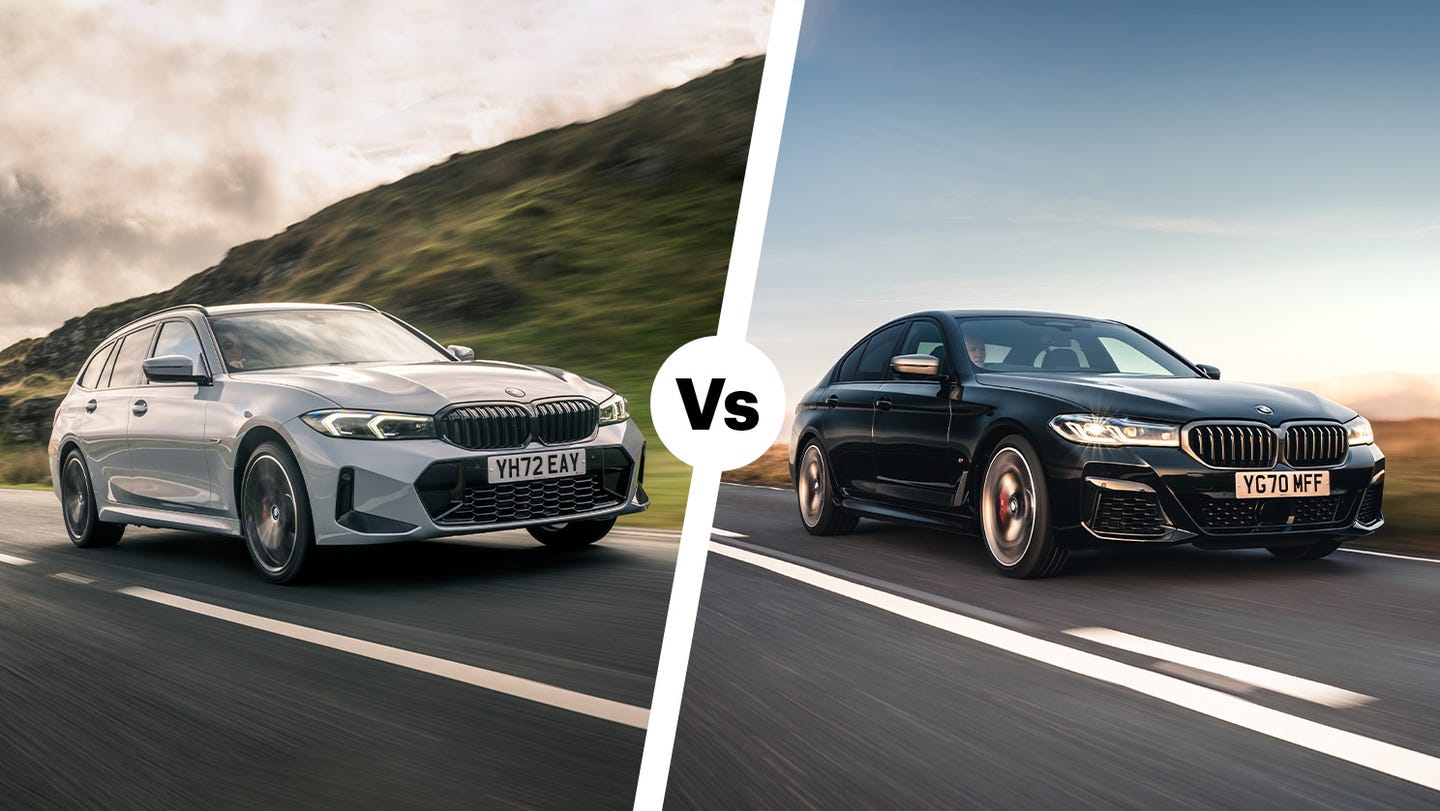







There’s a big price difference between these two – is the M5 worth the extra over the M3?
BMW’s M3 and M5 models are iconic: for decades they’ve offered an enticing blend of everyday practicality and exciting performance. The latest models are almost family racing cars – both are especially fast, noisy and steroidal – but the way they approach the performance is completely different. Let’s see which one is best.
BMW M3 vs M5 compared
| BMW M3 | BMW M5 |
Pros:
| Pros:
|
Cons:
| Cons:
|
Styling
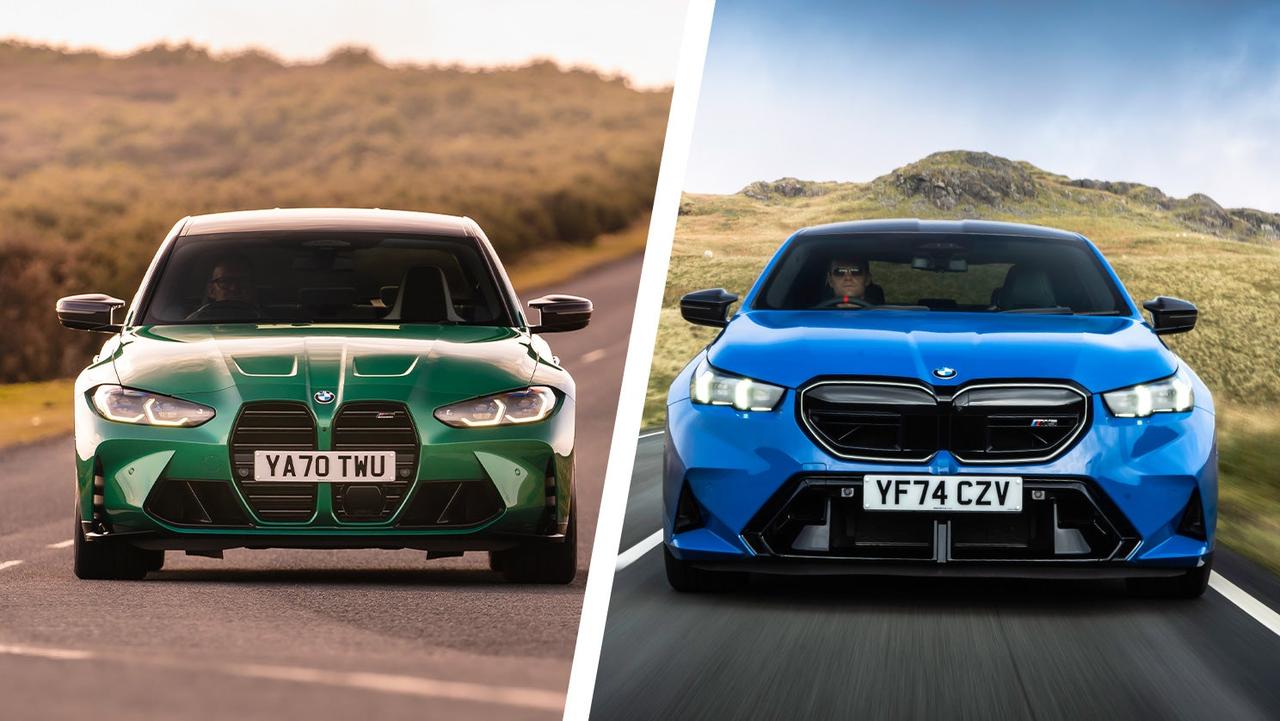
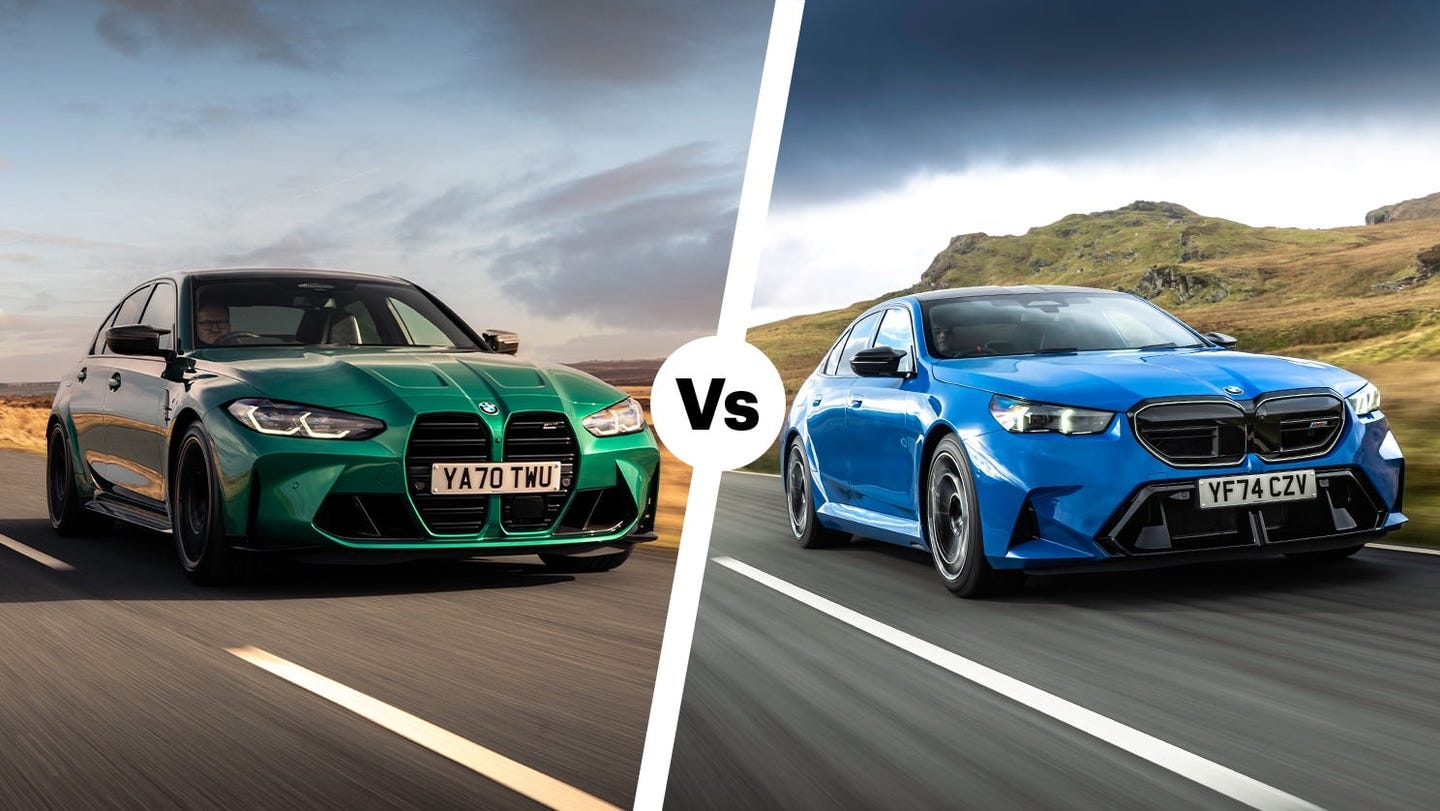
The current ‘G80’ M3 has always had divisive styling, and a recent facelift only included slight tweaks. Its tall grilles, fake bonnet vents and radar system integration are all questionable, although there’s no mistaking it over a normal 3 Series. It’s a very presenceful, purposeful shape.
Compared to the 3 Series, even the standard 5 Series looks a bit bloated and doesn’t quite have the same chiselled looks. The M5 looks even more swollen in pictures. In reality, the size is still immediately obvious but the M5’s stance looks fantastic. We’re not totally sold on the large black plastic panels in the grilles, but overall the M5’s design is a bit more cohesive than the M3’s.
Want a high-performance version of either of these cars with a bit more subtlety? There’s the M340i, which could easily be mistaken for any other petrol 3 Series, while the electric i5 M60 provides the sheer acceleration thrills but without the rousing engine note.
Interior and technology
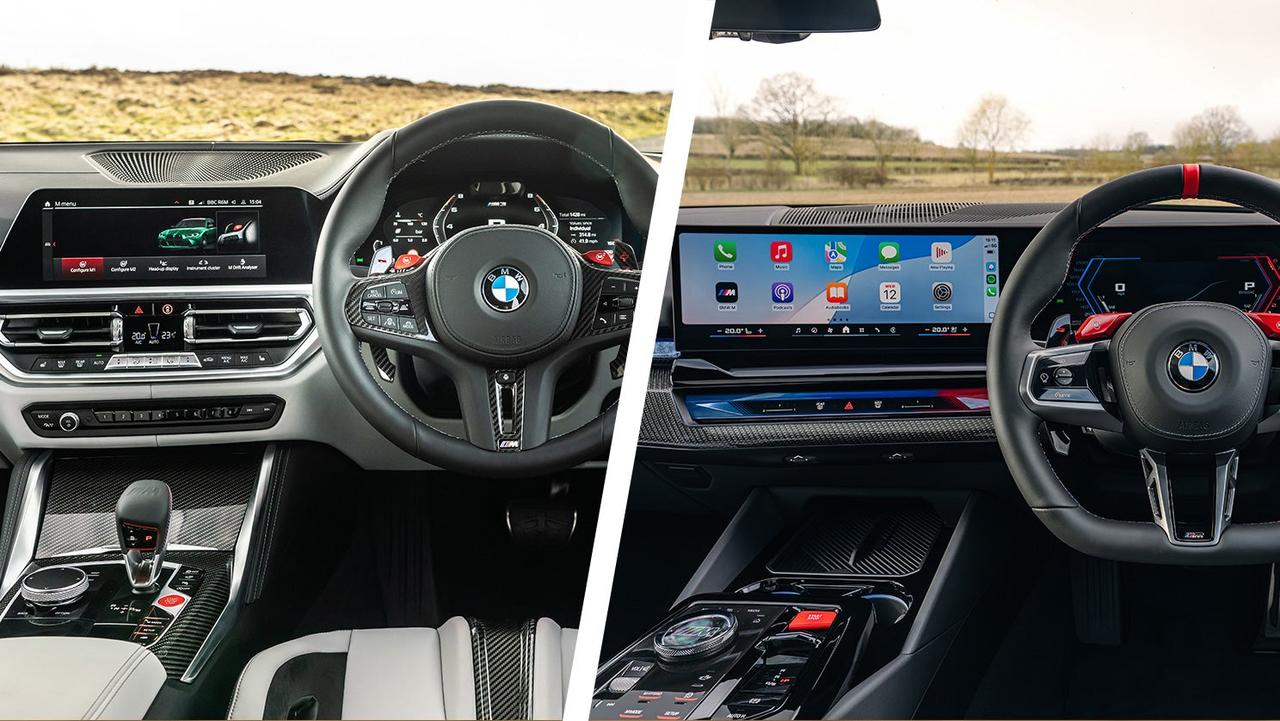
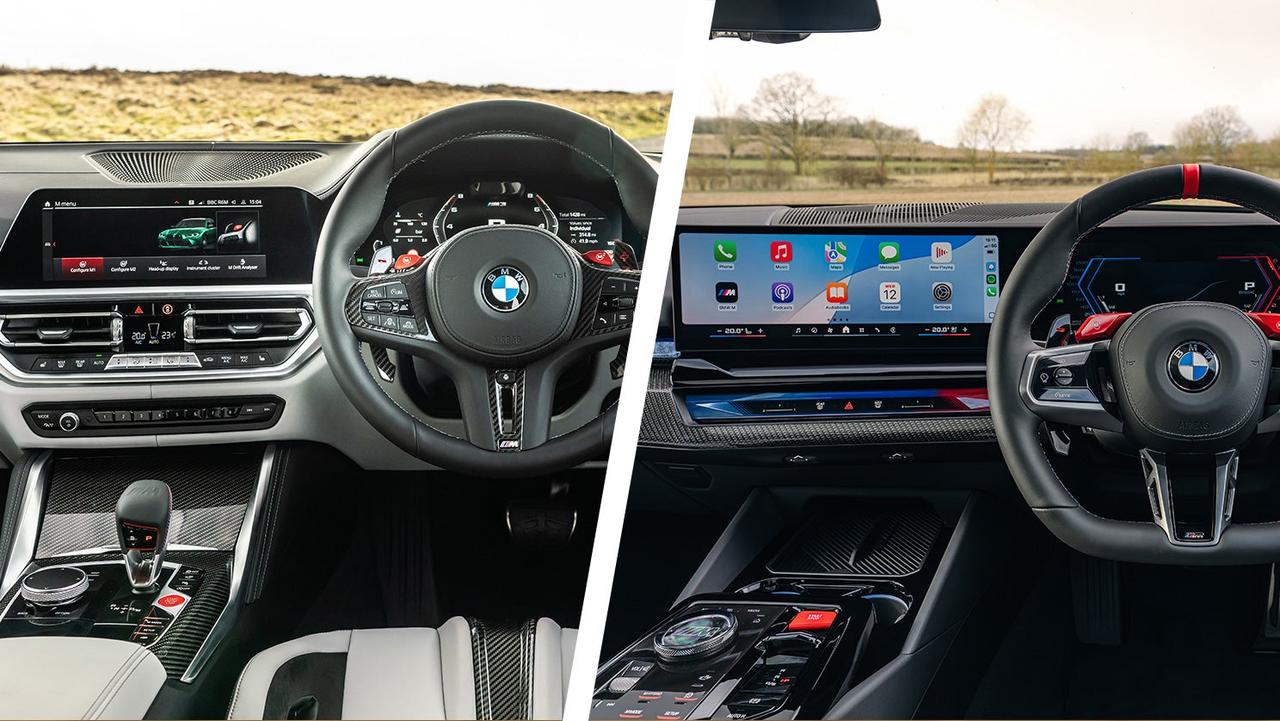
The main hardware of these two cars is broadly similar: both get a curved panel featuring two large screens, plus a thick steering wheel and a smattering of buttons on the centre console. Both feature BMW’s iDrive controller that makes it a lot easier to cycle through the seemingly neverending touchscreen menus.
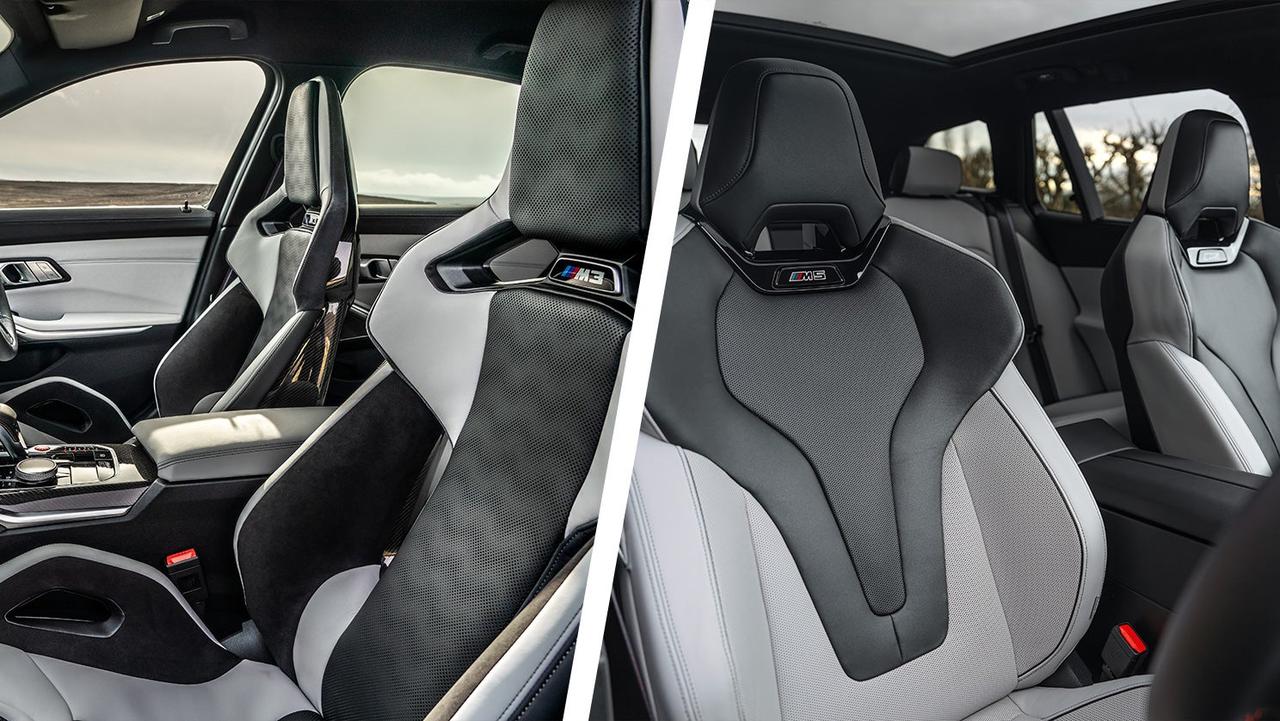
The M5’s interior design feels a bit newer (because it is), with a smaller gearlever, more touch buttons and some very fancy-looking ambient lighting panels. The M3 wins for the number of upholstery colour choices, and you can opt for extroverted bright orange or bright blue leather alongside some classier picks.
Unsurprisingly, the costlier M5 scores better for standard equipment. You get things like a heated steering wheel and adaptive LED headlights thrown in with an M5, whereas they’re bundled into an expensive option pack in the M3. Even the carbon fibre trim option is more expensive in the M3 than in the M5, although you do get more of it in obvious places throughout the cabin.
Dimensions and practicality
| BMW M3 | BMW M5 | |
| Length | 4,801mm | 5,096mm |
| Height | 1,438mm | 1,516mm |
| Width (inc/exc mirrors) | 1,903/2,068mm | 1,970/2,156mm |
| Wheelbase | 2,857mm | 3,006mm |
| Boot space (seats up) | 480 litres | 500 litres |
The M5 is considerably bigger than the M3 and it feels it. As well as being too long to comfortably fit in a car park space, the M5’s width makes it more of a challenge on tight country roads.
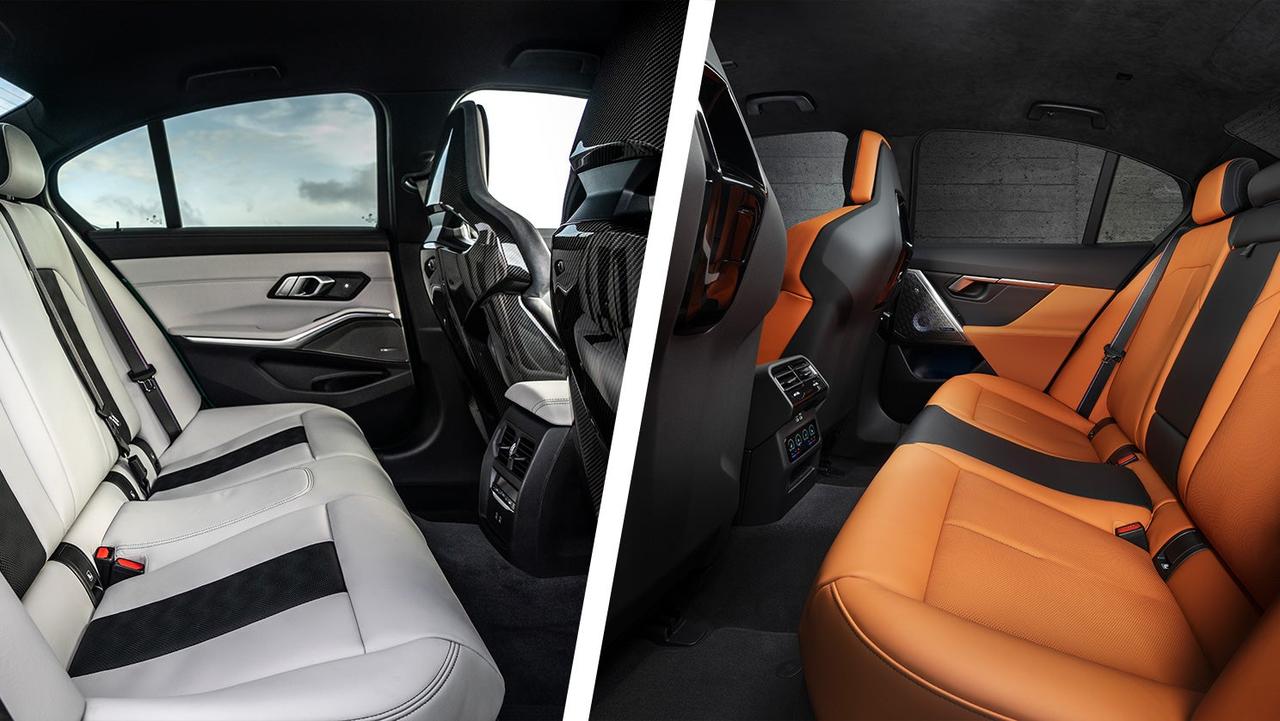
As highlighted by the increased wheelbase, the M5 offers more interior space than the M3, with ample rear-seat room compared to the M3’s adequate space.
There’s no noticeable difference in boot space, though. That’s because the M5 is a plug-in hybrid and the batteries have to go under the boot floor. Both are available as Touring estate models, which give you a wider aperture and more luggage space if you load above the parcel shelf. However, the latest 5 Series Touring got rid of the handy opening rear windscreen, which you still get on the 3 Series Touring.
Engines and performance
| BMW M3 | BMW M5 | |
| Engine size | 3.0-litre inline-six | 4.4-litre V8 + e-motor |
| Power and torque | 530hp, 650Nm | 727hp, 1,000Nm |
| 0-62mph | 3.5 seconds | 3.5 seconds |
| Top speed (with limiter removed) | 180mph | 190mph |
| Official fuel economy | 27.7mpg | 55.4mpg |
| Electric range | - | 40 miles |
| Weight | 1,865kg | 2,515kg |
Two completely different approaches to performance – but exactly the same 0-62mph time. The M5’s extra 200hp is there to overcome its significant weight penalty, brought on by its plug-in-hybrid engine.
Opting for this powertrain brings a couple of advantages. First, the M5’s 40-mile electric range makes it significantly cheaper to run than the purely petrol-powered M3 (if you charge at home). Second, it gives the M5 a duality that the always-on M3 doesn’t, making the bigger car a better long-distance cruiser. Third, you get a V8 engine. We’re big fans of the M3’s S58 straight-six, but eight cylinders is more – and that’s better.
The M5 feels enormous on a tight road, whereas the slightly narrower M3 feels a bit more suited to our twisty roads. Being a lot lighter, the M3 is also more agile than the M5, and slightly more fun.
Value
Without any options, a brand-new M3 starts at over £91,000, compared to £116,000 for the M5. Once you’ve added the Ultimate Pack and the M Race Track Package to the M3, you’ll be at nearly £115,000 – while the similar pack on the M5 takes you to £135,000.
Having been on sale longer, the M3 is both more widely available and can be picked up for less than the current M5. But you might argue that the M5’s extra space, exclusivity and mountain of power is worth the extra cost.
Which is best?
The M3 and M5 are both good cars with some key differences. The M3 is more agile and a bit less expensive (hardly cheap, though!) and you can enjoy the same tech and boot space as the M5. If you’re buying a BMW M car to drive around fast corners or on a racetrack, the M3 will be the better choice.
Upgrading to the M5 brings you noticeably more passenger space, a slightly nicer interior, better fuel efficiency and a wider range of driving experience customisation options. It’s a better choice for a family or for long-distance cruising. There’s also the argument that, if you’re spending this much money, you might as well go for the flagship model.
Shop used BMW cars for sale at Motorpoint, or read our BMW reviews.