












APR stands for Annual Percentage Rate.
It's an important factor in deciding how much your car finance costs. You can use APR as a guideline to compare different finance agreements to see which offers the best value for money.
What is APR and how does it work?

When you take out a car finance agreement, you're effectively borrowing money from a lender to pay for a car. Like a loan or a mortgage, you repay that borrowed money in small monthly instalments. You also pay a little extra on top for the convenience – that extra money is called interest.
APR is a percentage rate that includes the interest you pay along with any extra fees charged by the lender. As a result, the APR shows you the 'cost' of borrowing that money over the course of a year.
For example, say you borrowed £10,000 over one year at 10% APR. That means, by the end of the year, you'll have paid back £11,000 in total – that's the £10,000 you borrowed plus 10% or £1,000 in interest and fees.
How is APR calculated?

APR is decided by the lender and is worked out based on a range of factors. The base interest rate set by the Bank of England plays a big role in most APR calculations. Beyond that, the APR is ultimately decided by balancing the lender's need to make profit against making the finance agreement competitive and affordable.
Representative APR vs Personal APR
| Representative APR | Personal APR | |
| What it means | The advertised APR rate on a finance agreement | The APR rate you're actually offered (which may be different) |
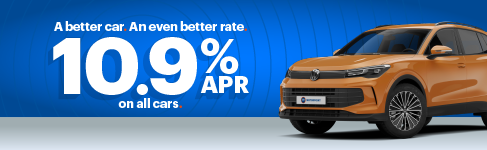
Car retailers can advertise their finance rates when selling cars. They are required to show what's called a 'representative APR'. This means a rate that at least 51% of successful applicants are ultimately offered. As a result, it is 'representative' of the kind of personal rate you might get offered.
As suggested, the 'personal APR' is the APR rate you're actually offered when you apply for finance. This rate will be influenced by your credit history. If your credit score isn't great, you'll either be offered a higher APR rate, or be declined for finance completely as you represent more risk to the lender.
APR vs interest rate
| APR | Interest rate | |
| Includes |
|
|
APR and interest rate are sometimes used interchangeably. Certainly, the main component of APR is the interest rate you'll pay on money borrowed, but APR also includes any fees charged by the lender on top of interest payments.
For example, you might take out a car finance agreement that has a 9% interest rate. If this agreement also charges fees at a rate of 3% per year, then your total APR will be 12%. This is the 9% interest rate combined with the 3% annual fees.
Fixed APR vs variable APR
| Fixed APR | Variable APR | |
| What it means | Your APR rate is fixed for the whole finance agreement | Your APR rate will go up and down over the finance agreement |
As the name implies, a fixed APR means the rate is fixed at one percentage for the whole finance agreement. This means your repayments won't be affected by market conditions and you'll have a clear picture of the total finance costs. Most car finance agreements are based on fixed APR rates.
A variable APR means the actual rate you pay will go up and down in line with market conditions. That could mean lower rates and repayments if the market is favourable, or it could mean higher costs if conditions aren't as good. Variable APR car finance is quite rare in the UK.
What factors affect APR?

The APR rate you end up being offered on a car finance agreement – your personal APR – is affected by several factors including:
Credit score and history
Your credit score and history have a significant impact on whether you'll be accepted for car finance, and the APR you're eventually offered.
If you have a good history of paying back money on time and spending within your means, there's a good chance you'll be offered the representative rate on a car finance agreement.
However, if you have bad credit history, with late payments or defaults on your record, then you'll either be offered a much higher APR, or you won't be accepted at all.
Deposit
How much initial deposit you put down on your car finance agreement won't directly affect the APR rate you're offered. However, it will substantially influence how much money you end up paying across the whole agreement.
If you put down a high initial deposit, the amount of money you borrow will be comparatively low. Since the APR is only calculated on the money you borrow, the total amount you'll pay will be low too.
Alternatively, if you put down a small deposit or no deposit at all, then you'll be borrowing much more money overall. As a result, you'll pay more in interest and fees than buyers who place down a big deposit.
Finance term length
How long your car finance agreement lasts is another factor that impacts how much you'll have to pay. Term length doesn't directly affect your APR, but does influence how much interest and fees you'll be charged over the agreement.
Typically, the shorter a finance agreement, the less interest and fees you'll pay, in exchange for bigger monthly repayments. If you want lower monthly repayments, you might choose a longer finance term length, but you'll usually pay more in interest and fees over that time.
Can I reduce my car finance APR?

Broadly speaking, no – you can't change your car finance APR once you've entered a finance agreement. The APR is set – and usually fixed – by the lender, and you'll be shown the rate before you agree to the finance package. Nevertheless, there may be other ways you can reduce your monthly car payments.
One option available is to refinance your agreement. This involves a new lender paying off your debt with the old lender and entering you into a new finance package. However, this is only a good option if you've made substantial improvements to your credit score since accepting the finance agreement, as you'll need the new lender to offer you a better rate than the old one.
Another option is to request an extension to your car finance agreement term. If you make your agreement longer, your monthly payments will go down as there's more months to spread them over. However, you'll almost certainly end up paying back more in total as you'll rack up more interest and fees with the lender.
Finance your next car with Motorpoint
Motorpoint has a handy car finance calculator to help you work out what kind of agreement is affordable for you. We offer competitive car finance and unbeatable prices on thousands of nearly new and used cars for sale.