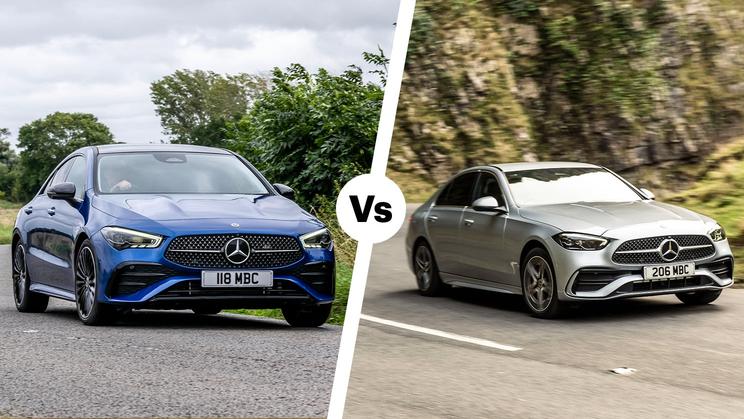






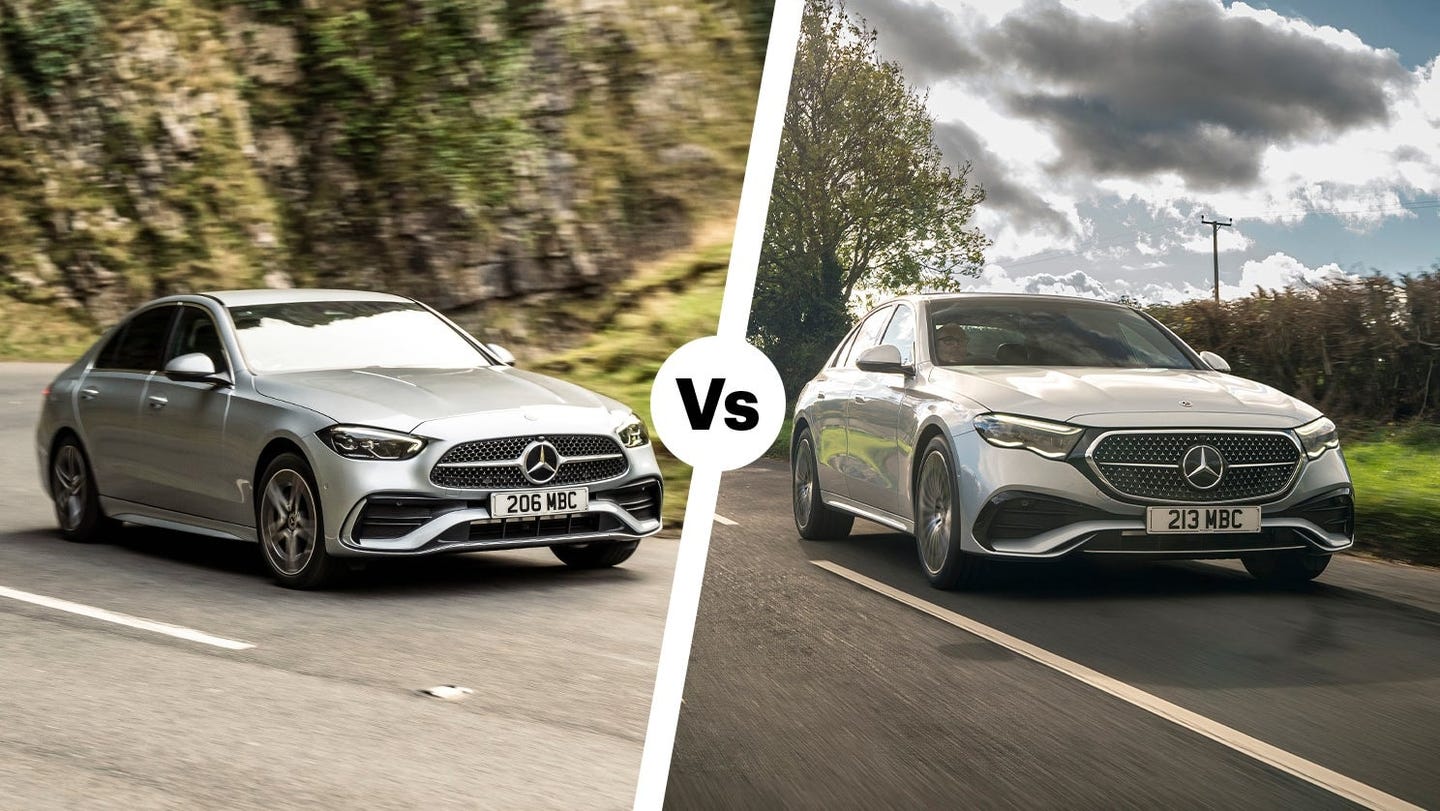

Mercedes is well known for its plush executive saloon models, and its C-Class and E-Class models are techy, comfortable and spacious.
Even though the A-Class and GLC are the big sellers, the C-Class and E-Class are still important cornerstones of Mercedes’ model range. Having been on sale for decades, both are iconic nameplates because of their breadth of abilities. Whether you’re going to be using your Mercedes for taxi duties, family life or storming down the German autobahn, the C-Class and E-Class are satisfying and shrewd choices. Here’s how to choose between them.
Shop used Mercedes C-Class cars and used Mercedes E-Class cars for sale at Motorpoint
Mercedes C-Class vs Mercedes E-Class compared
| Mercedes C-Class | Mercedes E-Class |
Pros:
| Pros:
|
Cons:
| Cons:
|
Styling
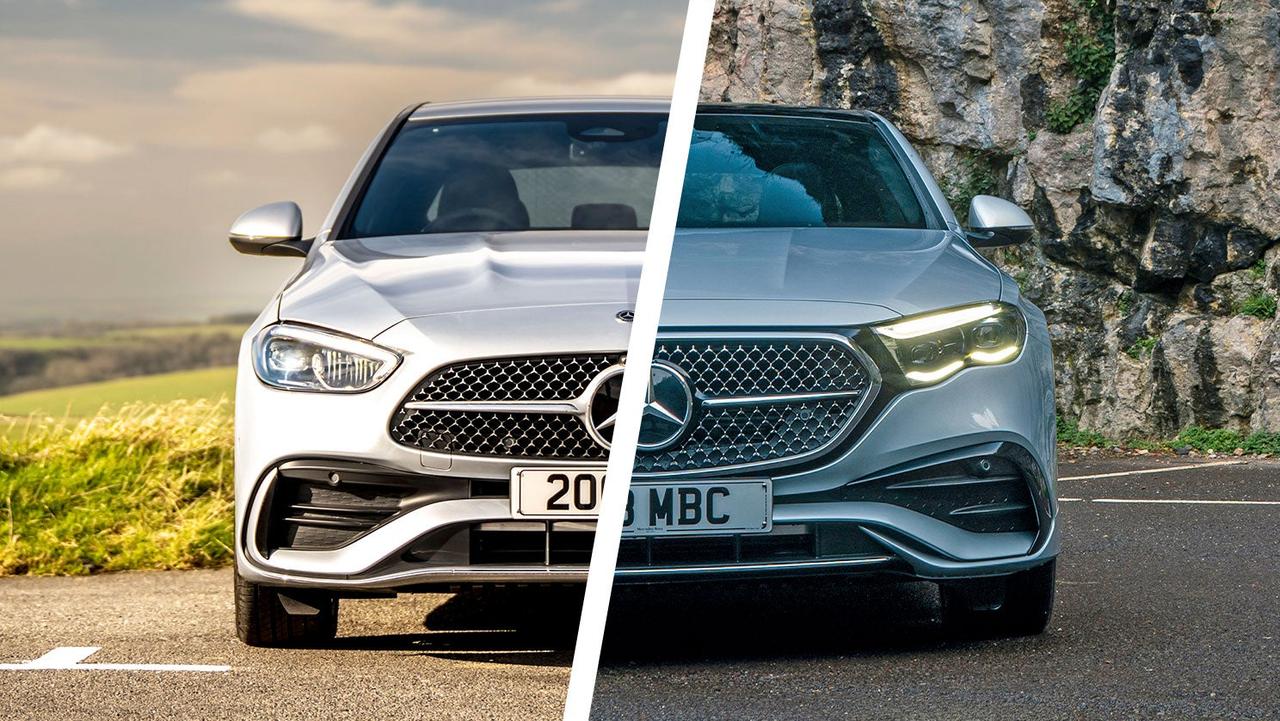
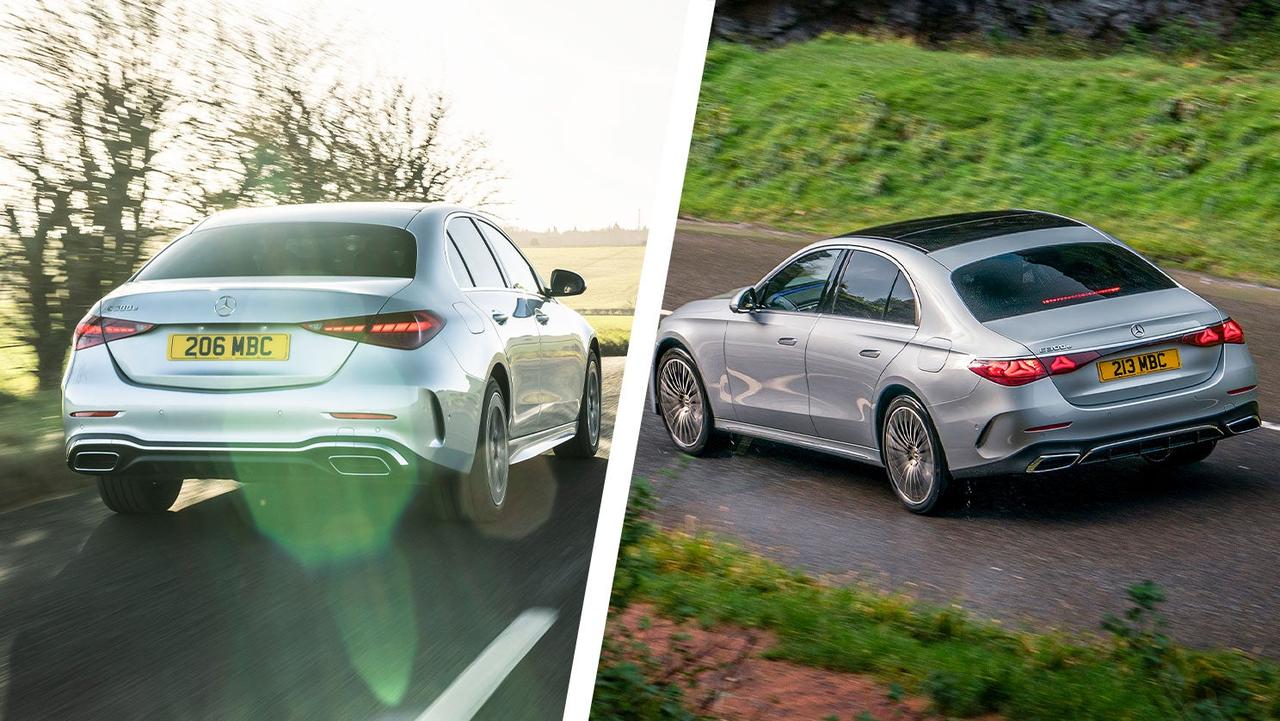
For a few years now, Mercedes has employed a Russian doll strategy for styling its saloons. If you weren’t paying close attention, you could easily mistake a C-Class or an E-Class for the flagship S-Class limousine. That means even the C-Class looks like an expensive and premium model.
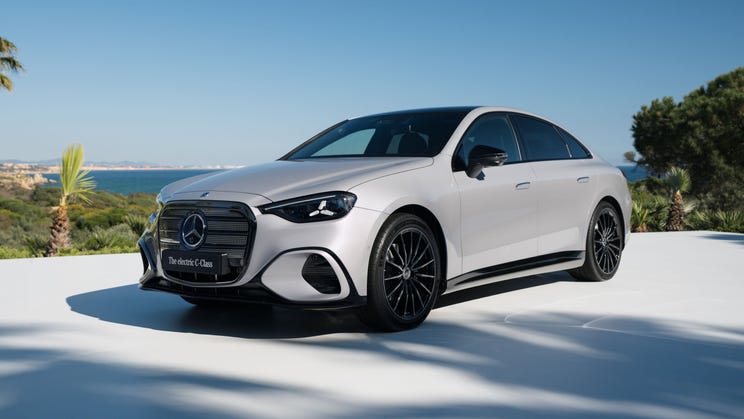
Being a slightly newer model, the latest E-Class follows Mercedes’ latest design trend, which is to go big on three-pointed star logos. They’re in the tail-lights, all over the grille and all across the dashboard if you don’t pick the optional passenger screen. You might find this all a bit unnecessary and verging on chintzy.
However, it’s nice to see that both still uses shiny chrome-like trim on the windowlines and grilles – this provides an elegant, timeless look.
Interior and technology
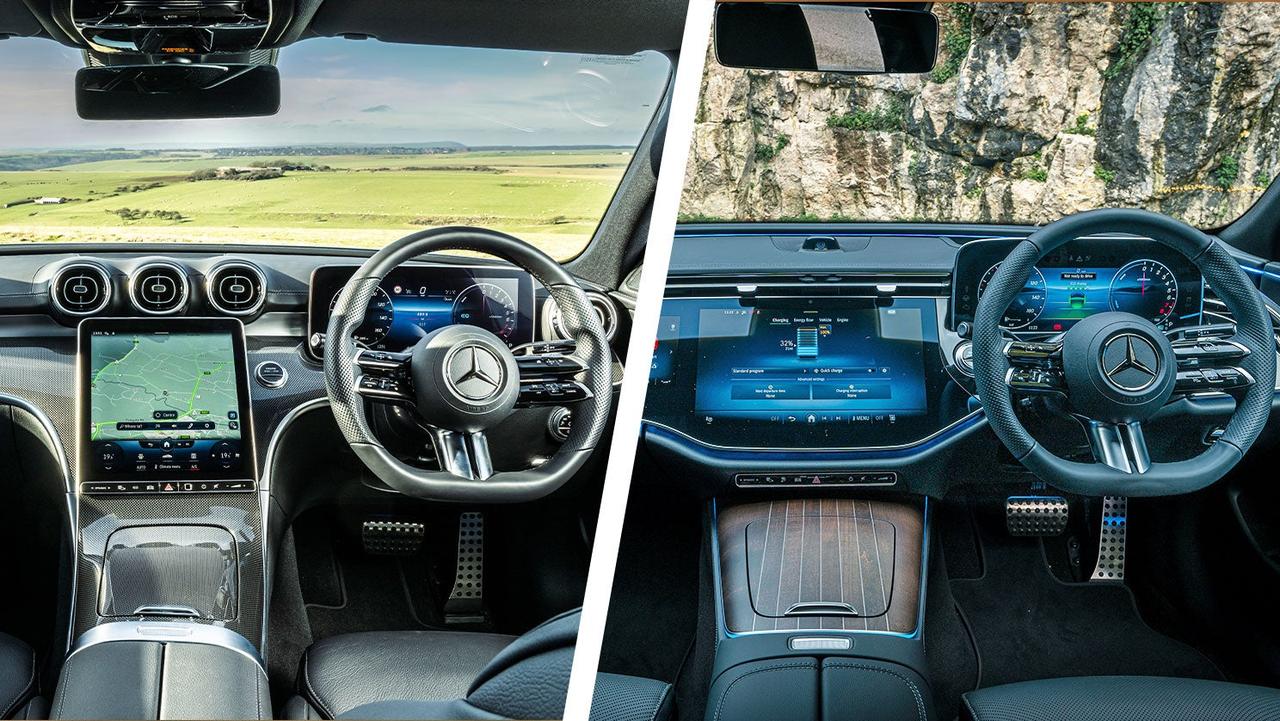
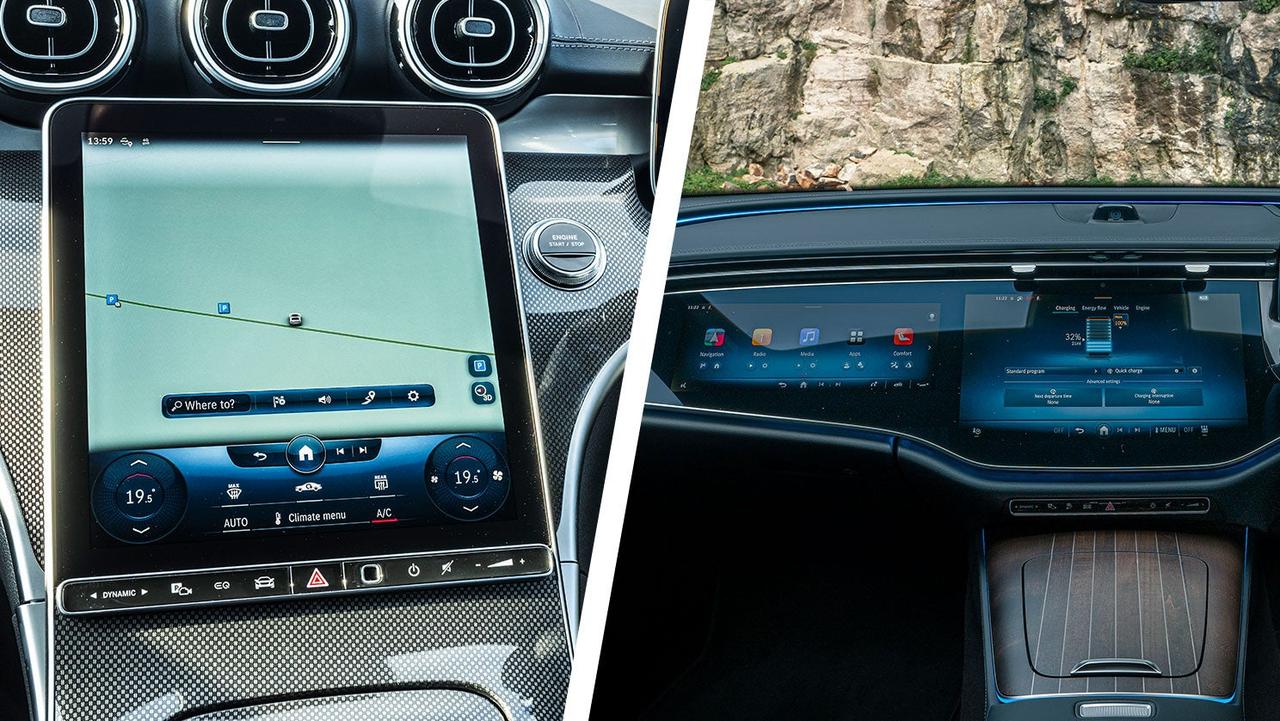
Hope you like screens… Mercedes’ latest MBUX infotainment system is displayed on a large touchscreen in both cars, although it’s laid out vertically in the C-Class and horizontally in the E-Class. This system looks the dog’s danglies, but it’s a little fiddly to use and you’ll be repeatedly looking away from the road to dive into the various submenus.
In the E-Class, you can option a ‘Superscreen’, which adds an additional touchscreen for the passenger and puts both touchscreens beneath a single pane of glass. You’ll either love this or be completely against it – or your decision to spec it might come down to whether your passenger would actually use it or would rather just scroll TikTok on their phone instead.
In isolation, there’s nothing wrong with the quality in the C-Class – it feels like a premium car and your passengers will enjoy the luxury. As you’d hope for the extra price, the E-Class feels slightly more luxurious, with a slightly wider spread of soft-touch materials. You can also choose more interior options in the E-Class, such as different wood finishes and upgraded Nappa leather in several colours.
You can't get real leather at all in the regular C-Class range – it's Mercedes' synthetic Artico leather instead, which is vegan. It's only the AMG models that you can spec real cow on.
Dimensions and practicality
| Mercedes C-Class | Mercedes E-Class | |
| Length | 4,751mm | 4,949mm |
| Height | 1,438mm | 1,468mm |
| Width (exc/inc mirrors) | 1,820/2,033mm | 1,880/2,065mm |
| Boot space (seats up) | 315-455 litres | 370-540 litres |
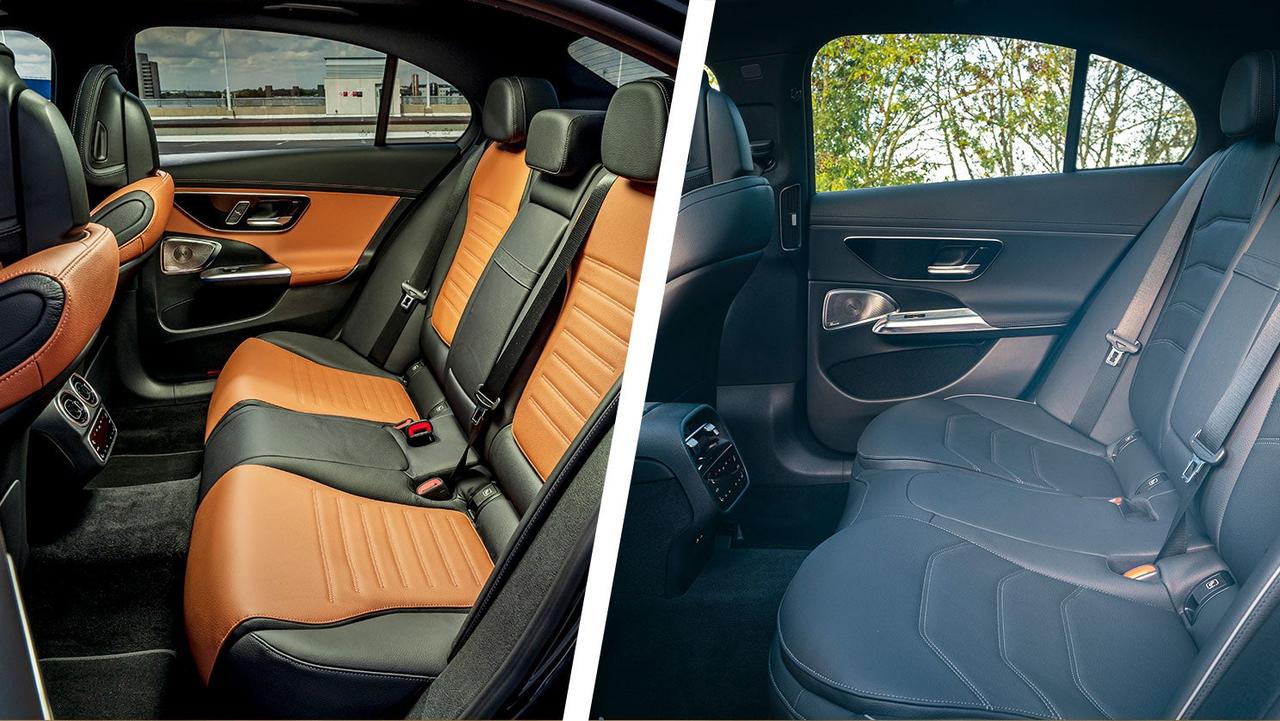
Being nearly 25cm longer, it’s not a massive surprise that the E-Class is more practical than the C-Class. Most passengers will have a comfortable amount of space in the C-Class, although tall adults may feel cramped. The E-Class gives you a bit more room to stretch your legs.
At the back, the C-Class’ 455-litre boot is a little down on its main rivals – the Audi A5 and BMW 3 Series – let alone the E-Class, which has a noticeably bigger 540-litre boot. However, the saloon boot opening on both cars restricts what you can fit in the boot; the C-Class Estate or E-Class Estate will be better choices if you need to carry bulky items.
You can get both these cars with plug-in-hybrid engines, which give you a generous fully electric range plus the backup of an engine for longer journeys. The downside of these models is a much smaller boot than petrol or diesel cars – the big battery has to go somewhere. You’ll struggle to fit a big shop into one of these PHEVs, which is disappointing considering how long these cars are. At least there’s no longer a big step in the boot floor, which is what you got in older Mercedes PHEVs.
Engines and performance
| Engine | Power and engine size | 0-62mph time (seconds) | MPG | Electric range (miles) |
| Mercedes C-Class | ||||
| C220d diesel | 220hp, 2.0 | 7.5 | 62.8 | - |
| C300d diesel | 285hp, 2.0 | 5.7 | 55.4 | - |
| C200 petrol | 224hp, 1.5 | 7.3 | 45.6 | - |
| C300 petrol | 278hp, 2.0 | 6.0 | 42.2 | - |
| C300e PHEV | 313hp, 2.0 + e-motor | 6.1 | 134.5 | 71 |
| C300de PHEV | 313hp, 2.0 + e-motor | 6.2 | 176.6 | 73 |
| AMG C43 4Matic petrol | 435hp, 2.0 | 4.3 | 30.7 | - |
| AMG C63 S e 4Matic PHEV | 680hp, 2.0 + e-motor | 3.4 | 31.4 | 7 |
| Mercedes E-Class | ||||
| E220d diesel | 220hp, 2.0 | 7.6 | 58.9 | - |
| E450d diesel | 380hp, 3.0 | 4.8 | 47.1 | - |
| E200 petrol | 227hp, 2.0 | 7.5 | 43.5 | - |
| E300e PHEV | 313hp, 2.0 + e-motor | 6.4 | 134.6 | 71 |
| E300de PHEV | 313hp, 2.0 + e-motor | 6.4 | 176.6 | 71 |
| AMG E53 4Matic PHEV | 585hp, 3.0 + e-motor | 4.0 | 91.2 | 60 |
Mercedes is the only manufacturer to currently sell a diesel-engined plug-in hybrid, and you can get both the C-Class and E-Class with this ‘300de’ engine that gives long-distance fuel efficiency and an impressive electric range for town journeys.
Both cars offer a couple of regular diesel engines alongside the 300de engine, with the six-cylinder E450d being a particular highlight (and rarer than rocking-horse plop). The E-Class only offers one conventional petrol engine, and we wonder why the C-Class can’t share its C300 engine with the bigger car.
AMG versions (not AMG Line!) have always had large engines and evocative soundtracks but, to curb emissions, you’ll spot that the C63 and E53 are now plug-in hybrids with smaller engines than before. This hasn’t gone down well with buyers and both these cars are rare.
Value
As new cars, the entry-level E-Class is a whopping £10,000 more than the cheapest C-Class, which buys you a bigger engine (but the same power), a slightly bigger car and a slightly more luxurious cabin.
Comparing two-year-old examples with similar mileage, the E-Class is still roughly £5,000 more than the C-Class. The C-Class is also more widely available on the used market so you should have more choice.
Which is best?
When the C-Class is as good as it is, it’s hard to make a case for the substantially more expensive E-Class. Unless you really need the extra space of the E-Class, we’d recommend picking the C-Class.
Shop used Mercedes C-Class cars and used Mercedes E-Class cars for sale at Motorpoint.