





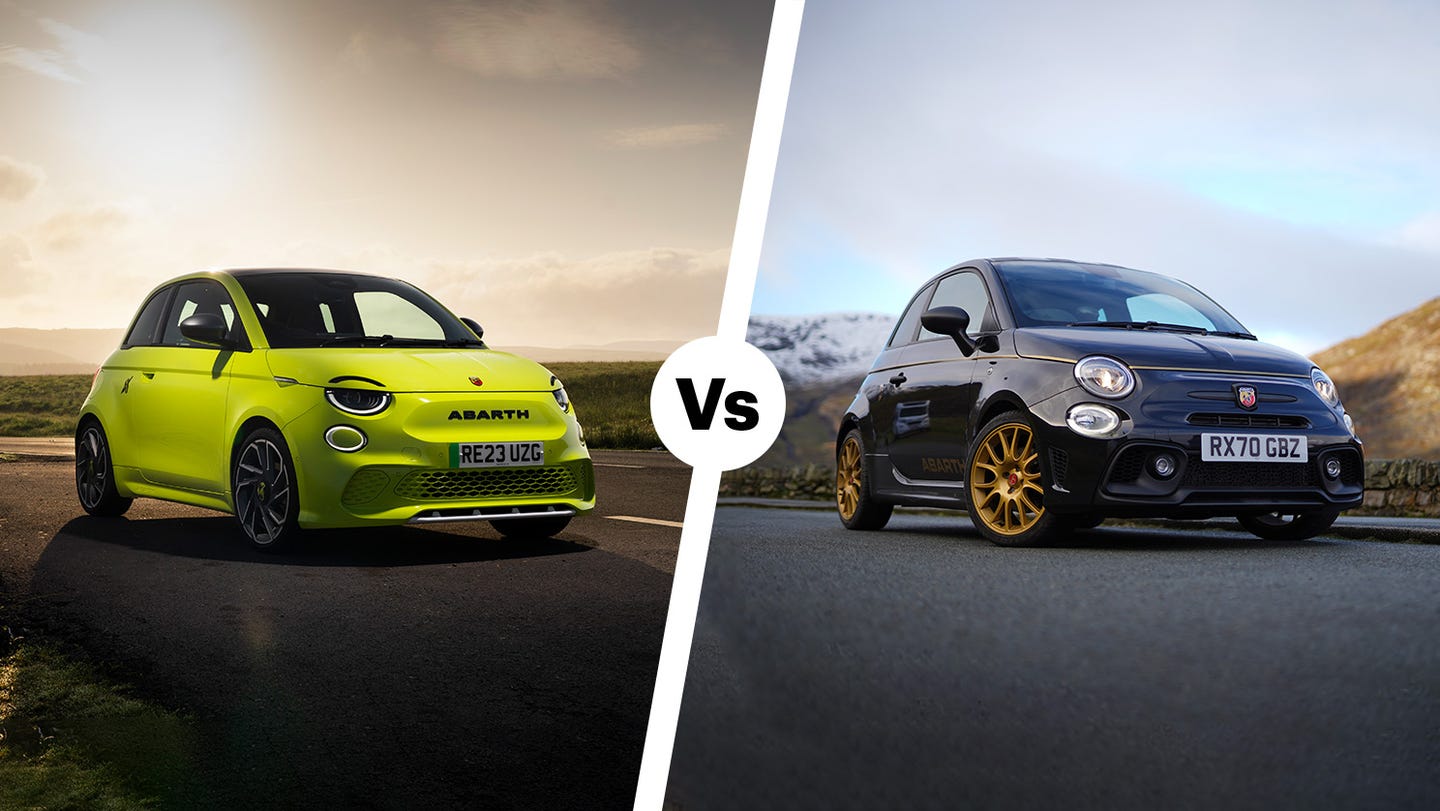

The Abarth 500e is the company's hot hatch for the 21st century.
It has all the flash and drama you'd expect from a scorpion-branded model. However, rather than a juvenile petrol engine, you get a zippy electric motor driving the wheels.
We'll compare the Abarth 500e against the old fuel-burning Abarth 595 here so you can pick your favourite.
Abarth 500e vs 595 compared
| Abarth 500e | Abarth 595 |
Pros:
| Pros:
|
Cons:
| Cons:
|
Styling and design
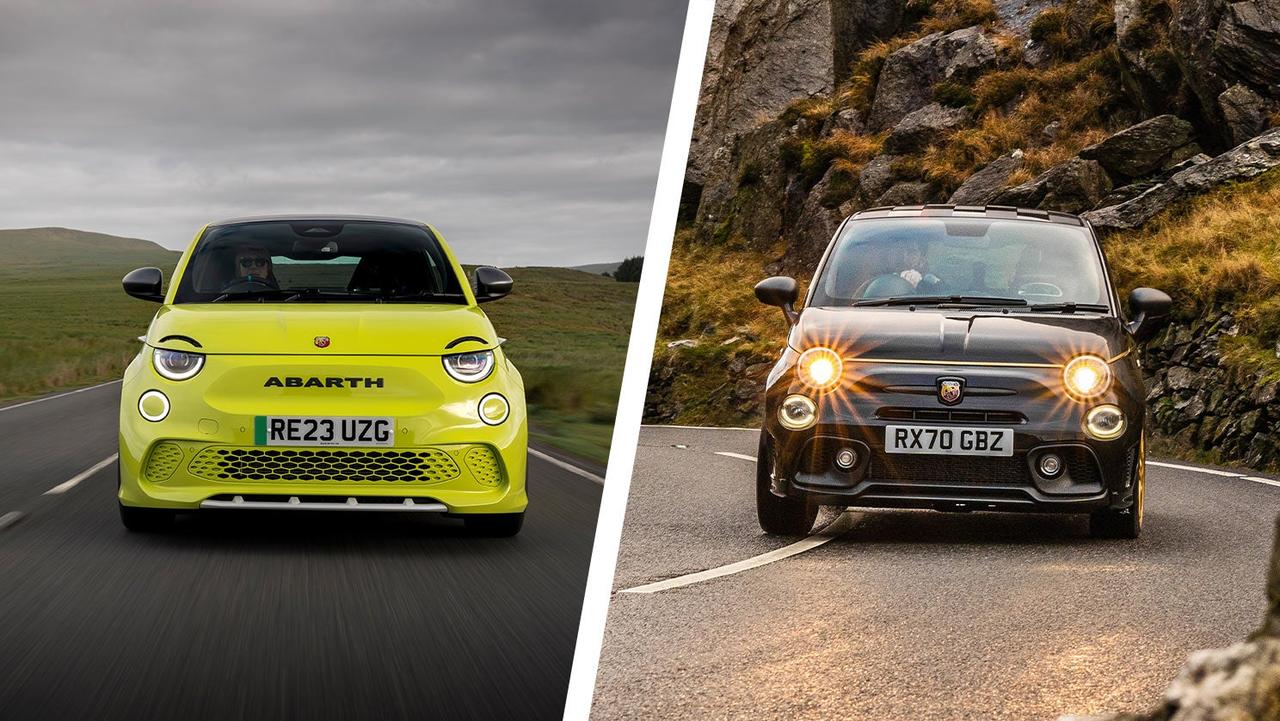
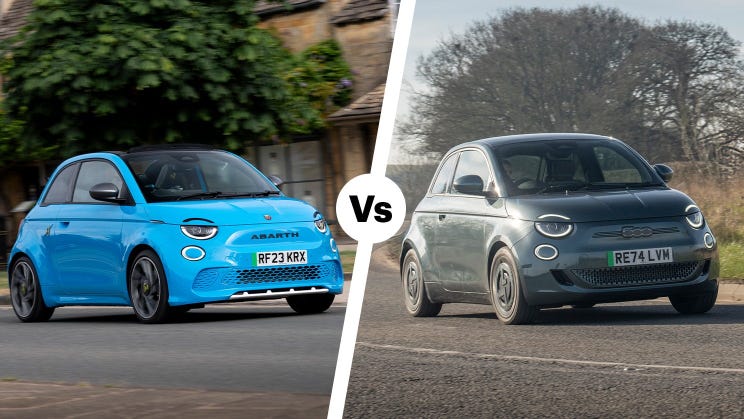
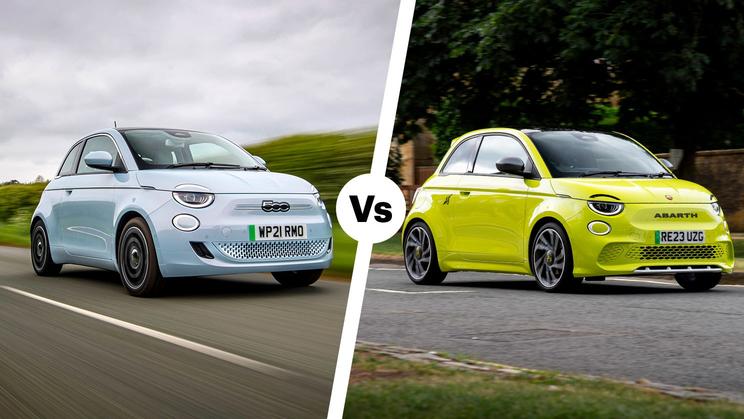
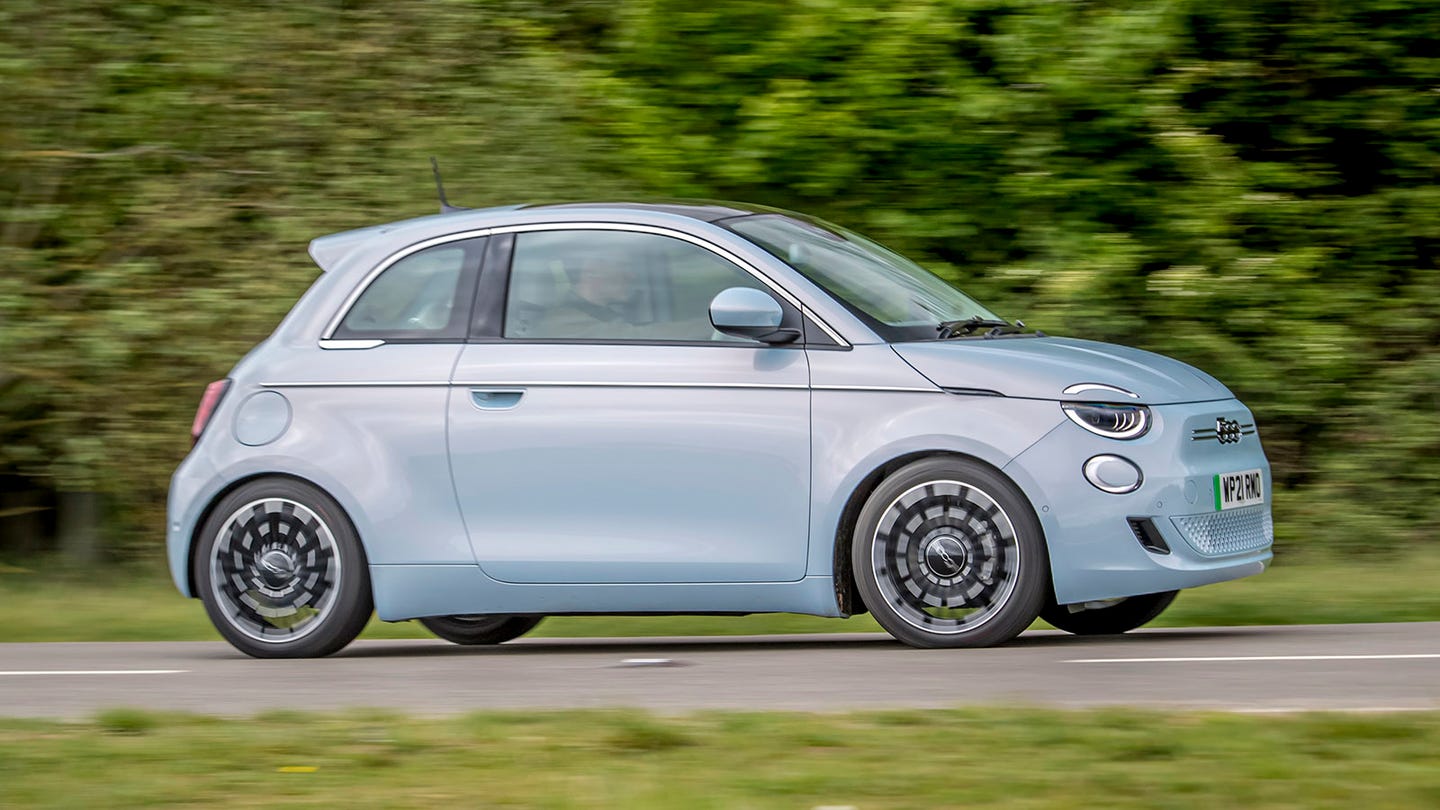
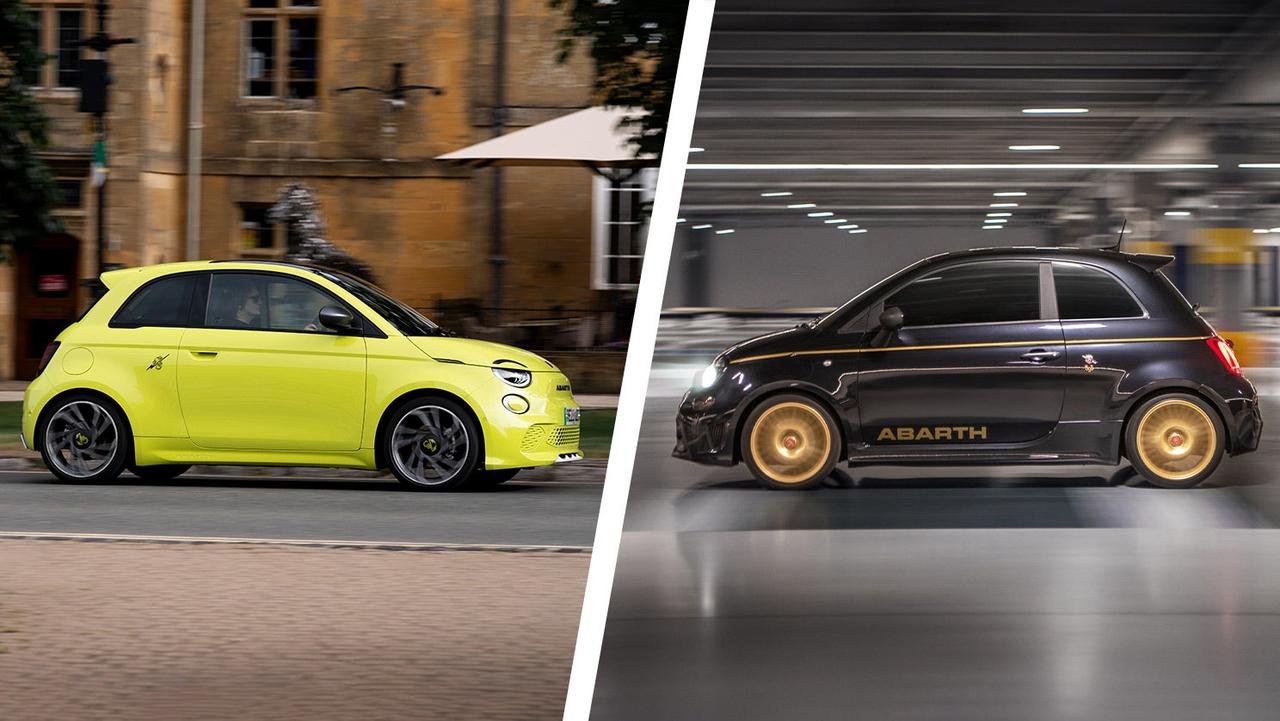
Both in pictures and in person, there's obvious shared DNA between the electric 500e and the petrol 595. The former may be the latter's replacement, but they both have looks directly cribbed from the '50s Fiat 500. That means friendly round headlights and dinky bodywork, complete with a rounded roof and a stubby tail.
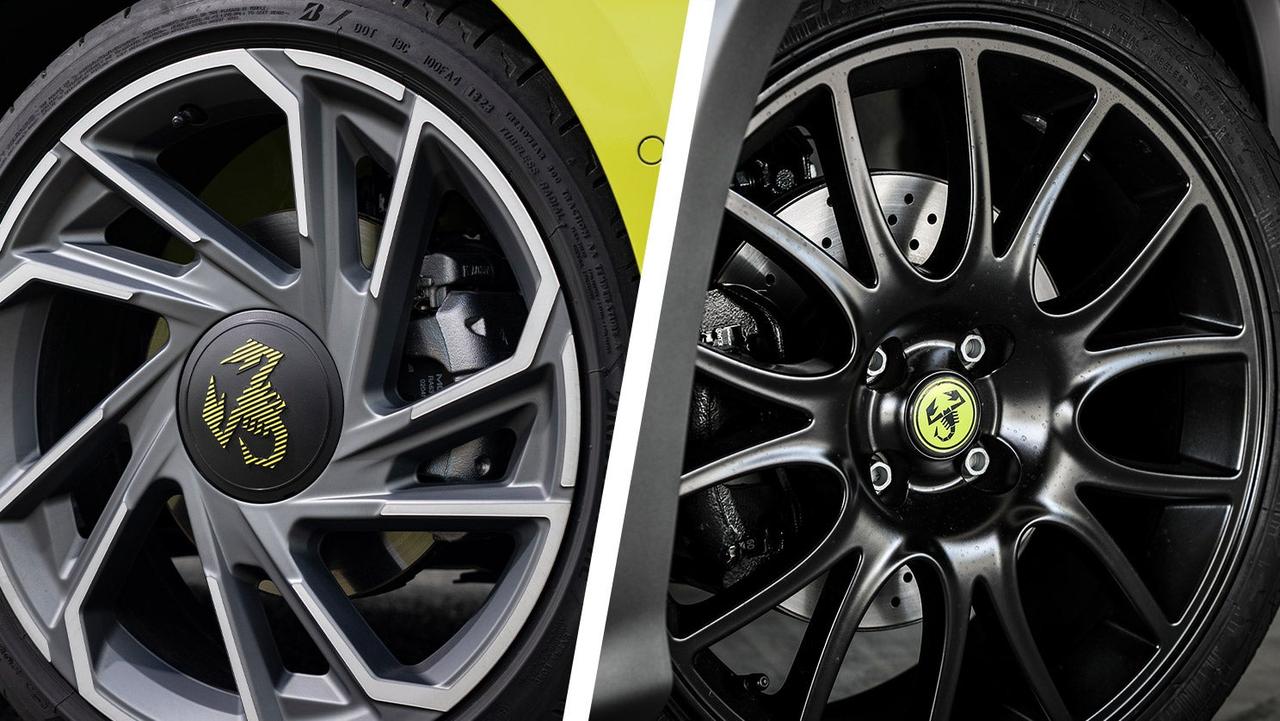
Of course, these aren't your typical Fiats, so they look both resplendent in their go-faster parts. That means deep bumpers and side skirts, plus widened wheelarches for a mean stance and hiding fatter wheels. These are completed by a selection of vibrant paint colours and race-car graphics packs. In a world of understated hot hatches, the Abarth pair aren't afraid to wear their sportiness on their sleeves.
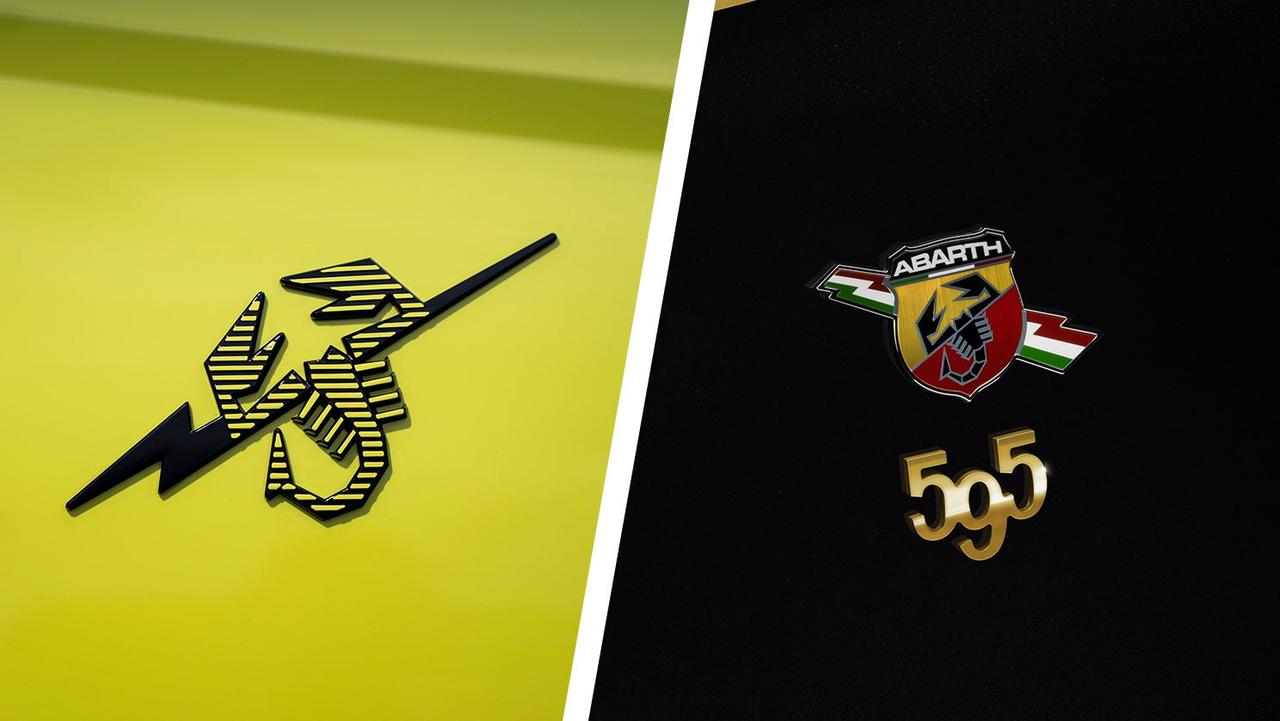
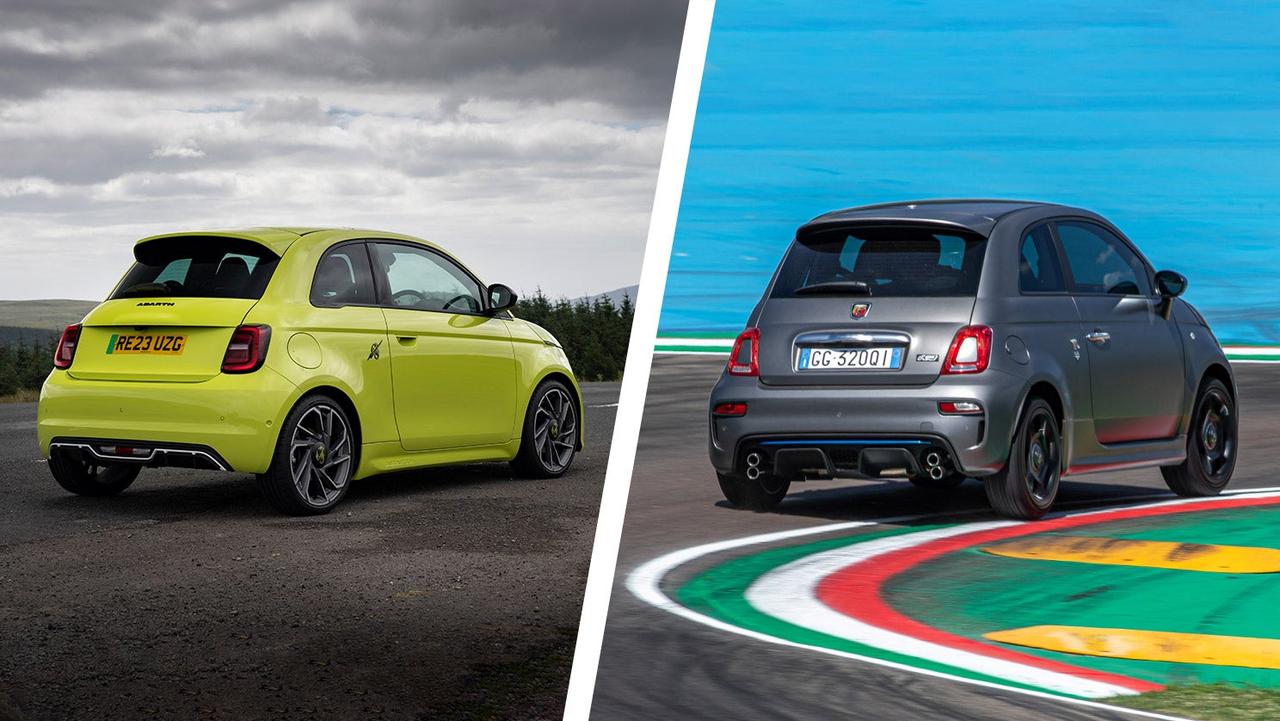
Nevertheless, eagle-eyed readers will be able to spot the differences. The 500e is slightly smoothed compared to the 595, without the upper air intake of the petrol-powered 595, presumably to give the electric model better aerodynamics. You also lose the 595's front foglights from the lower bumper, although the 500e trades back with a reflector on the trailing edge of the bonnet and new badging around the side windows.
Interior and practicality
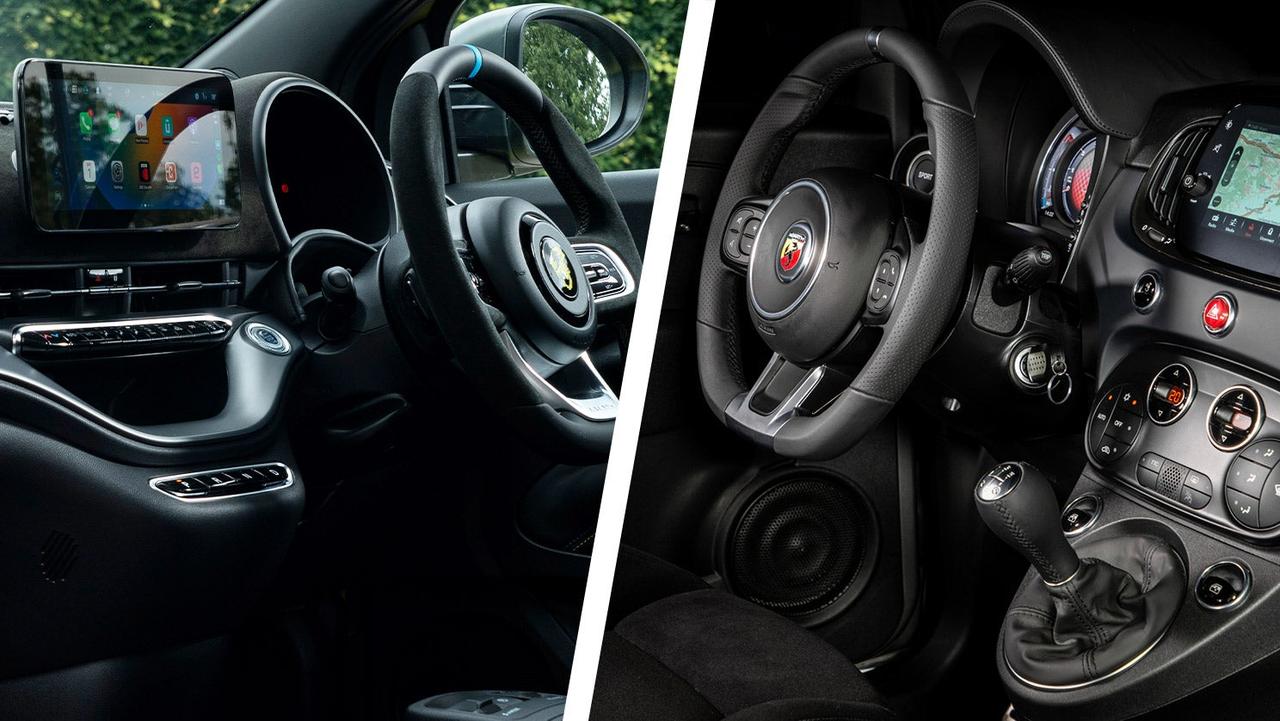
Like the outside, the new 500e evolves the outgoing car's design rather than reinvent it. The dashboard structure is still vaguely oval-shaped and puts you in mind of 1950s refrigerators. You'll find the gear selector underneath the dash on both cars, but rather than the snappy manual shifter in the 595, it's a series of simple buttons in the auto-only 500e. Similarly, the 595's distinctive 'pod' for the drivers dials remains in the 500e, but it's now jelly-bean shaped instead of the old car's circle.
The infotainment system in the 500e is a substantial improvement over the old 595, which had a tiny little display that looked like a child's toy. There's more visual real estate thanks to a wider screen, so menus aren't as cramped as they are in the 595. Persistent on-screen shortcut buttons make it easy to jump between the 500e's functions, but it's a bit disappointing that Abarth hasn't flipped them over for right for right-hand-drive cars.
Structurally, the 500e's platform is an update of the existing 595. That means it's barely grown between model generations, so space is just as limited in the new car as it is in its predecessor. There's space for single drivers or couples, with just enough front-seat space and acceptable cargo room with the rear seats folded down. Passengers relegated to the rear seats will only want to be there for very short journeys, as there's restricted headroom and virtually no legroom, even sat behind average-height adults.
Size and dimensions
| Abarth 500e | Abarth 595 | |
| Length | 3,673mm | 3,660mm (-13mm) |
| Width (exc mirrors) | 1,682mm | 1,627mm (-55mm) |
| Height | 1,518mm | 1,485mm (-33mm) |
| Boot space | 185 litres | 185 litres (+0 litres) |
The electric Abarth 500e is near-enough the same size as the old 595. As a result, passenger space is just as tight in the new car. Cargo space is unchanged between the two, measuring 185 litres with the rear seats in place. Many owners may find those back seats spend more time folded than they do in use.
Engines and performance
| Abarth 500e | Abarth 595 | |
| Engine | Permanent-magnet synchronous electric motor | 1.4-litre turbo four-cylinder |
| Power | 155hp | 140-180hp |
| Torque | 235Nm | 206-250Nm |
| 0-62mph | 7.0 seconds | 6.6-7.6 seconds |
| Top speed | 93mph | 127-140mph |
This is the headline difference between the 500e and the 595. The former uses a front-mounted electric motor – in fact, the same motor as the standard Fiat 500e, just fed more electrons so it spins up quicker. Meanwhile, the old 595 kept the same 1.4-litre turbo petrol engine mostly unchanged through its entire production run. Fully charged, the 500e's 164-mile range isn't great by anyone's standards but should be enough for local runs or second-car duties.
The boosted petrol engine was a big part of the 595's character. It wasn't overwhelmingly fast, with anywhere between 140 and 180hp, but every version felt very eager and insistent thanks to the car's light weight. Plus, every single journey was accompanied by a rowdy exhaust note that lies just to the right or wrong side of obnoxious, depending on your tastes.
Side-by-side, we're not sure the battery-powered 500e's setup quite lives up to the old petrol car. It's responsive and reasonably quick, as we expect from pretty much all EVs these days, but it just doesn't feel like it's pinning you to your seat like the hottest 595s do. You do get a built-in sound generator, which mimics the sound of the old petrol car both inside and out. It definitely livens up the experience versus a near-silent EV, but still can't quite match the more visceral thrill of the fuel-burning 595.
Driving
The 500e might not scratch the performance itch the same way the 595 does, but it gets much closer on the open road. Both cars feel planted and firm, with lots of grip and stability despite their very short wheelbases. Neither car comes with a proper mechanical limited-slip differential, but both use their brakes to shuffle torque across the front axle to 'pull' the car more tightly into corners.
Older 595 models were substantially improved by the optional frequency-selective dampers – first supplied by Koni then later as Abarth's own design. This mostly eliminated the brittle, hard edge found on the standard suspension setup and actually made the car easier to live with for daily driving. Thankfully, the standard setup in the electric 500e mostly retains the qualities of the 595's upgraded suspension, making it a fraction more comfortable across the whole range than entry-level 595 models.
As you'd expect, neither car is particularly refined. The old 595 generated noise from nearly everywhere – engine drone, tyre roar, suspension thuds and wind whistle were constant companions. For the most part, this is the same in the 500e, especially as the car's digital sound generator simulates the engine noise found in the old car. You can turn the sound generator off – via a deeply fiddly user interface – but this just serves to amplify the car's many other sounds, so you might as well leave the fake engine on for your own entertainment.
Value and reliability
Abarth models are usually much more expensive than the humble Fiat models they're based on. And, while they have many go-fast accessories, you can still see evidence of their cut-price origins if you look closely. These are cars you should buy with your heart rather than your head.
From a pure price perspective, the old 595 has been around much longer than the 500e, so the used market has many more affordable examples available. That said, discounts on the 500e have been steep once it ends up as a nearly new or used car, driven partially by the early depreciation EVs tend to suffer. As a result, good deals can be had on 500e models that are just a year or so old.
Perhaps surprisingly, the old 595's 1.4-litre turbo engine has proven to be reasonably stout, with no major reliability issues reported on unmodified units. The 500e hasn't really been on sale long enough to get a picture of its long-term dependability, but we assume it should be even better since electric cars have fewer moving parts than petrol ones.
Which is best?
What lies beneath the bonnet of these cars is likely to be the biggest factor in your decision. The newer 500e still feels like an Abarth on the open road, with swift performance and fun handling. Plus, if you can charge at home, your running costs will be much lower than a petrol Abarth.
But many drivers in this segment are looking for something for seat-of-the-pants thrills, and that's something the more raucous 595 does just a little better than the newer car. It's also the obvious choice for drivers who don't have a designated parking space, with the extra flexibility afforded by the ability to refuel.
Big savings on used Abarth cars
Search a selection of used Abarth cars for sale at Motorpoint. For even more choices, see our picks for the best hot hatches on sale.
Read our Abarth 500e review and Abarth 595 review for a more in-depth look at these cars.